
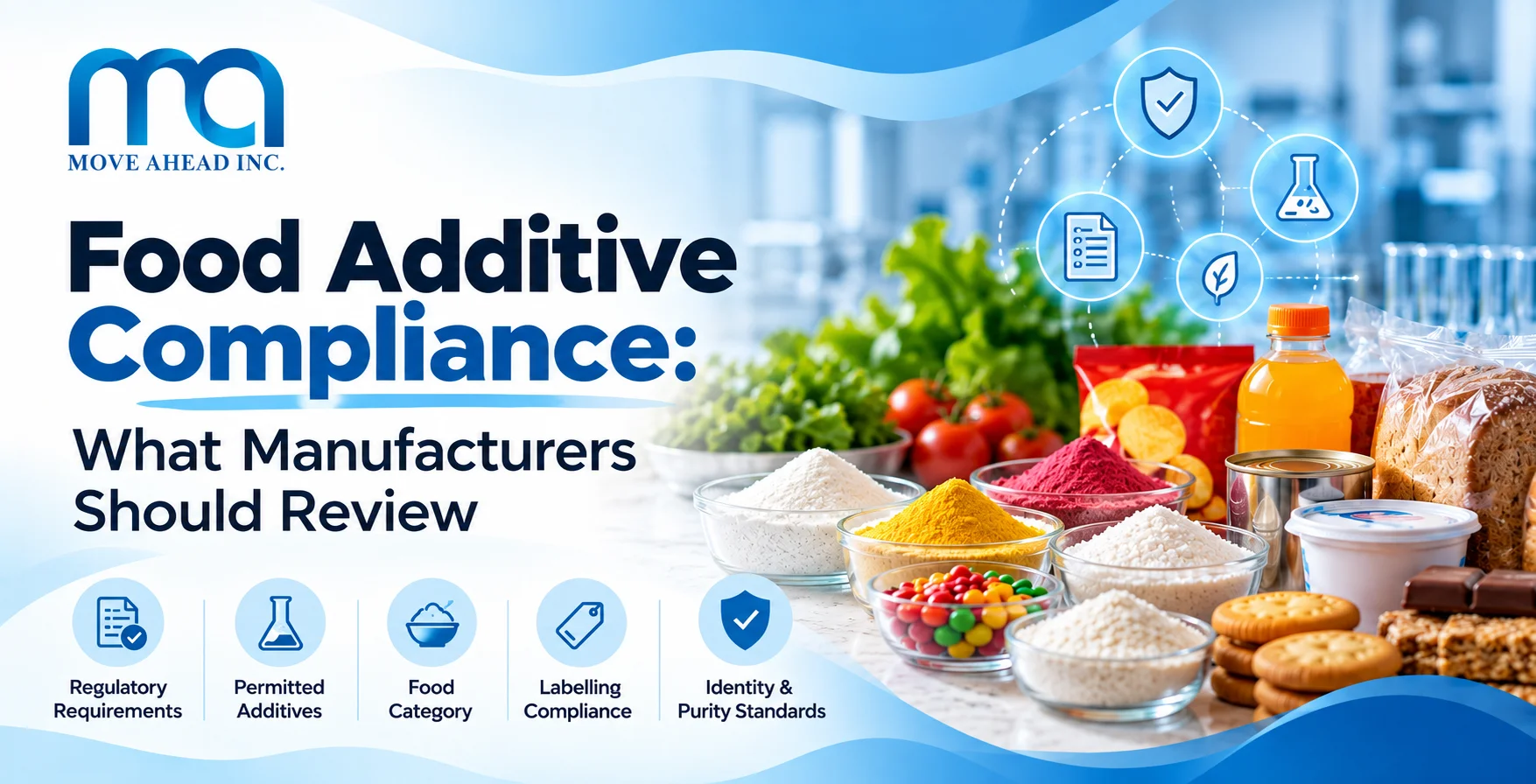
Food Additive Compliance: What Manufacturers Should Review
 30th September, 2026
Food Additive Compliance: What Manufacturers Should Review
Food additive compliance means confirming that every additive in a formulation is permitted for the exact food category, performs an allowed technological function, stays within the applicable maximum or good-manufacturing-practice condition, meets identity and purity specifications, and is declared correctly on the label. A substance being widely used or internationally permitted does not automatically make it compliant in India.
Manufacturers should complete this review before pilot production, label printing, import, contract manufacture or commercial sale. The control must cover additive preparations, carriers and processing aids as well as obvious ingredients. Move Ahead supports food product compliance and related regulatory work for manufacturers entering or operating in India.
The legal framework to check
The central reference is the Food Safety and Standards (Food Products Standards and Food Additives) Regulations, 2011, as amended. Other relevant rules may include the Labelling and Display Regulations, licensing requirements, contaminants and residues limits, nutraceutical regulations, and the approval framework for non-specified foods and ingredients. The applicable set depends on the product.
FSSAI’s regulations page warns that a compendium is a ready-reference document and that original notifications and amendments prevail if there is an error or overlap. Therefore, record the version date of every regulatory source used and check recent Gazette notifications, directions and implementation dates before sign-off.
A 10-step food additive compliance review
1. Build a complete formulation inventory
List every input with supplier name, trade name, common name, INS number where applicable, percentage in the premix, dose in the finished food, technological function and processing stage. Break compound ingredients and premixes into their components. An “flavour system” or “stabilizer blend” cannot remain a regulatory black box.
2. Classify the finished food correctly
Permission and maximum level often depend on the food category or standardized product. Determine whether the product falls under a specific standard, a proprietary food route, a health supplement category or another framework. Document why the selected category matches composition, process, presentation and intended use.
3. Confirm the additive is permitted in that category
Search the current additive provisions using the additive name, synonyms and INS number. Verify category-specific permission rather than relying on a general additive list. Where the text says GMP, use only the lowest quantity needed to achieve the legitimate technological purpose and maintain evidence for the chosen dose.
4. Check the technological function
An additive may be allowed as a preservative, colour, emulsifier, stabilizer, anticaking agent, sweetener or another function. The formulation, label and technical file should use the function recognized for the intended application. Using a permitted substance for an unsupported purpose can create a compliance issue.
5. Calculate the final use level
Convert premix addition into the concentration of each active additive in the finished food. Include additive contributions from compound ingredients and carry-over. Compare like units—mg/kg, mg/L, percent or another basis—and account for concentration or reconstitution where the rule requires it.
For example, if a premix contains 10 percent of an additive and is dosed at 0.2 percent, the theoretical additive level is 0.02 percent, or 200 mg/kg, before considering processing loss or contribution from other inputs. The compliance file should show the formula and assumptions, not only a supplier declaration.
6. Review carry-over and processing-aid treatment
Carry-over is not a blanket exemption. Confirm whether an additive present through an ingredient is permitted under the relevant conditions and whether it still performs a technological function in the finished food. Processing-aid status also requires a defensible function and residual profile; it should not be used simply to avoid declaration.
7. Verify identity and purity specifications
Collect a current specification, certificate of analysis, allergen statement, GMO status where relevant, origin, residual solvent or heavy-metal information, microbiological limits and storage conditions. Match the material received to the regulated identity. Trade-name equivalence must be demonstrated by composition.
8. Check label declaration and warnings
Review the ingredient list, functional class, specific name or recognized identifier, allergen information, vegetarian/non-vegetarian declaration and any mandatory warning for the additive type or product. Claims such as “no artificial preservatives” must be tested against every input and carry-over source.
Move Ahead’s food label compliance service can support a separate artwork review. Additive permission and label wording should be approved together because a formulation correction can change ingredient order, declarations and claims.
9. Confirm manufacturing controls and records
Define approved suppliers, weighing tolerances, premix preparation, line clearance, segregation, rework controls, batch records and change approval. Calibrate dosing equipment and set an investigation threshold. Formulation legality on paper is not enough if manufacturing variation can exceed the maximum permitted level.
10. Complete release and change control
Quality and regulatory personnel should sign a pre-launch checklist linking formulation revision, category rationale, permission, calculations, supplier documents, label proof and license scope. Any supplier, purity, dose, process, pack size, claim or regulation change should trigger impact assessment before the next batch.
Food category errors that create risk
Category selection is frequently more difficult than additive lookup. A beverage concentrate, reconstituted drink, confectionery filling and dietary supplement can have different provisions even when their marketing language overlaps. Do not select a category solely because a competitor label uses it.
Create a classification memo describing product composition, manufacturing process, consumer use, serving instructions and closest standardized definition. If two categories appear possible, document the conservative interpretation and seek expert or authority guidance. Move Ahead also offers product approval support where a non-specified ingredient or product route needs assessment.
Maximum level, GMP and quantum satis are not interchangeable
A numerical maximum is a legal ceiling, not a formulation target. Manufacturing variability and analytical uncertainty should be considered so routine batches remain below it.
GMP permission requires a technological justification and the minimum effective amount. “Quantum satis” similarly does not mean unlimited use; the amount must achieve the intended effect without misleading the consumer.
Imported additives and premixes
Imported material must satisfy Indian requirements even if it is compliant in the exporting country. Review the ingredient composition, Indian permission, shelf life, labels, certificates, importer license and customs documentation. A foreign specification referencing only Codex, EU or US rules is not an Indian compliance conclusion.
For a proprietary blend, obtain a confidential composition through an appropriate regulatory or quality channel. If the supplier will not disclose component percentages, the manufacturer cannot calculate final use levels reliably. Contract terms should require advance notice of formulation, site or raw-material changes.
Additives in nutraceuticals and special-purpose foods
Health supplements, nutraceuticals, foods for special dietary or medical use and novel foods may be governed by a dedicated framework in addition to general additive provisions. Review permitted ingredients, additives, dosage forms, warnings, claims and recommended-use limits together. A conventional-food permission should not be transplanted automatically.
Testing strategy
Not every additive can or should be tested in every batch, but the verification plan should be risk-based. Consider identity testing of high-risk raw materials, supplier qualification, periodic finished-product assays, preservatives at end of shelf life, colour or sweetener verification, and contaminants associated with the source.
Use an appropriately recognized laboratory and an applicable method. Compare analytical results with formulation calculations and investigate differences. Testing supports compliance; it does not replace a regulatory permission review. A perfectly measured concentration can still be non-compliant if the additive is not allowed in that category.
Documents to keep in the regulatory file
- Approved master formula with additive quantities, functions, INS numbers and finished-product concentrations.
- Food-category rationale and citations to current regulations and amendments.
- Supplier specifications, certificates of analysis, declarations and change-notification agreements.
- Calculation sheets for active additives, premixes, carry-over, concentration and reconstitution.
- Artwork approval with ingredient declarations, warnings, claims and allergen checks.
- Trial and validation reports showing technological need and minimum effective GMP dose.
- License and product-approval records, import documents where relevant, and regulatory correspondence.
- Batch records, deviations, complaints, adverse findings, recall readiness and periodic review log.
Common food additive compliance failures
Typical failures include relying on a supplier’s “FSSAI approved” statement without category evidence, missing additives inside flavours or premixes, confusing maximum level with recommended dose, using the wrong unit, overlooking carry-over, and retaining obsolete artwork after reformulation. Another risk is applying an international permission without confirming India-specific conditions.
A broader food license review should confirm that the business, site and activities are covered. Manufacturers can also review Move Ahead’s regulatory insightsand About Us for service context.
Pre-launch approval gate
| Gate | Evidence | Owner |
|---|---|---|
| Classification | Category memo and applicable standard | Regulatory |
| Permission | Additive provision and amendment date | Regulatory |
| Dose | Calculation and tolerance | R&D / QA |
| Material | Specification and supplier approval | QA / Procurement |
| Label | Approved artwork and claim review | Regulatory / Marketing |
| Manufacture | Validated dosing and batch record | Production / QA |
| Release | Signed checklist and test plan | QA |
Do not release the product because each department completed its own task independently. The gate works only when one controlled dossier connects product identity, formulation, process, label and license. Assign a named approver, revision number and effective date. Archive superseded decisions so the company can explain why a historical batch was considered compliant at the time.
Worked example: reviewing a stabilizer premix
A beverage developer proposes a stabilizer premix at 0.35 percent. The premix specification lists three hydrocolloids, an anticaking agent and a carrier, but only the blend name appears in the draft formula. Regulatory first expands the premix into each component and verifies the beverage category. R&D then calculates the finished level of each component and records its technological function.
Quality matches the supplier specification to current identity and purity requirements and checks allergen and change-control statements. Labelling confirms the required functional-class declaration and ingredient order. If one component is not permitted in that beverage category, reducing the dose may not solve the problem; the formulation needs an alternative premix or a defensible different product route.
Managing reformulation and supplier changes
A new supplier with the same additive name can have a different carrier, assay, particle size, residual profile or processing aid. Treat supplier substitution as a controlled formula change until equivalence is documented. Recalculate dose using actual assay, review artwork if carriers or allergens change, and repeat critical performance or stability work.
Marketing changes also matter. Moving from “regular” to “no preservatives,” “natural,” “sugar-free” or a child-focused positioning can expose conflicts that were not relevant to the original product. Regulatory should approve claims before creative development so the business does not print packaging that the formulation cannot support.
Supplier qualification questions for additives
Ask who manufactures the additive, which site and process are used, whether the material is food grade, what specification and test methods apply, how each batch is released, and how deviations are handled. Obtain a traceability statement, shelf life, packaging and storage controls, complaint history where appropriate, and a written change-notification period. For imported materials, confirm Indian importer responsibilities and document alignment.
High-risk ingredients may justify an audit or enhanced verification. Risk factors include complex botanical sources, colours susceptible to adulteration, allergen cross-contact, a long broker chain, variable assay or a history of regulatory alerts. Supplier approval should be proportionate to risk but never reduced to collecting a generic certificate.
Frequently Asked Questions
1. What is a food additive under FSSAI rules?
It is a substance not normally consumed as food itself that is intentionally added for a technological purpose and becomes, or may become, a component of the food. Because regulations and permissions can change, verify the current consolidated text and original Gazette notifications for the exact ingredient, category and use level before commercialization.
2. Is every INS-numbered additive permitted in India?
No. An INS number identifies a substance but does not prove permission for every Indian food category or use level. Because regulations and permissions can change, verify the current consolidated text and original Gazette notifications for the exact ingredient, category and use level before commercialization.
3. What does GMP mean for additive use?
Use the lowest amount needed to achieve the legitimate technological effect under good manufacturing practice and document the justification. Because regulations and permissions can change, verify the current consolidated text and original Gazette notifications for the exact ingredient, category and use level before commercialization.
4. How do I calculate additive level from a premix?
Multiply premix dose by the active additive percentage, convert to the required unit and add contributions from all other sources. Because regulations and permissions can change, verify the current consolidated text and original Gazette notifications for the exact ingredient, category and use level before commercialization.
5. Do processing aids need review?
Yes. Confirm the technological role, residual presence, specifications and whether the claimed processing-aid treatment is supportable. Because regulations and permissions can change, verify the current consolidated text and original Gazette notifications for the exact ingredient, category and use level before commercialization.
6. Can I rely on a supplier declaration?
It is supporting evidence, not the full assessment. The manufacturer must check the exact composition, category, dose and finished-product label. Because regulations and permissions can change, verify the current consolidated text and original Gazette notifications for the exact ingredient, category and use level before commercialization.
7. Are Codex-permitted additives automatically allowed in India?
No. Codex can inform assessment, but Indian regulations and notifications determine compliance for the Indian market. Because regulations and permissions can change, verify the current consolidated text and original Gazette notifications for the exact ingredient, category and use level before commercialization.
8. Must additives be listed on the label?
Declaration depends on the applicable labelling rules, functional class, specific additive and any carry-over or processing-aid condition. Because regulations and permissions can change, verify the current consolidated text and original Gazette notifications for the exact ingredient, category and use level before commercialization.
9. What happens if two food categories seem applicable?
Prepare a classification rationale and obtain qualified guidance before launch. Do not select the category only because it offers a higher additive limit. Because regulations and permissions can change, verify the current consolidated text and original Gazette notifications for the exact ingredient, category and use level before commercialization.
10. How often should an additive review be updated?
Review at every formula or supplier change and periodically against new amendments, directions and implementation dates. Because regulations and permissions can change, verify the current consolidated text and original Gazette notifications for the exact ingredient, category and use level before commercialization.
11. Does laboratory testing prove additive compliance?
Testing confirms identity or concentration, but permission, function, category and label compliance still require documentary review. Because regulations and permissions can change, verify the current consolidated text and original Gazette notifications for the exact ingredient, category and use level before commercialization.
12. When may product approval be relevant?
It may be relevant when a product or ingredient is non-specified under the applicable Indian framework. The exact route requires case-specific assessment. Because regulations and permissions can change, verify the current consolidated text and original Gazette notifications for the exact ingredient, category and use level before commercialization.
Turn Every Additive Decision into Traceable Evidence
A defensible additive file shows not only what was added, but why it is permitted, how the final level was calculated and how the claim reaches the consumer correctly. For a category, formulation and artwork review tied to current Indian requirements, contact Move Ahead before pilot production or commercial launch.





-
Food Additive Compliance: What Manufacturers Should Review
Posted on Sep 30, 2026
-
How to Identify Reliable Ingredient Sourcing Partners
Posted on Sep 23, 2026
-
FSSAI Renewal
Posted on Mar 24, 2026
-

The Importance of Compliance in Cosmetic Regulations
Posted on Jul 28, 2025
-

How to Avoid Misleading Cosmetic Claims in India: A Guide to Regulatory Compliance and Responsible Marketing
Posted on Jul 04, 2025
-
FSSAI Compliance in 2025-How to Get Food Compliance in 5 Easy Steps
Posted on Apr 17, 2025
-

Importance of Product Compliance
Posted on Jun 27, 2024
-
12 Myths about Food Product Compliance
Posted on Sep 21, 2023
-

Rutf Foods
Posted on Feb 22, 2023
-

Understanding Food Labelling Regulations in India
Posted on Feb 01, 2023