
Regulatory Strategy for Health Supplements in India
 7th October, 2026
Regulatory Strategy for Health Supplements in India
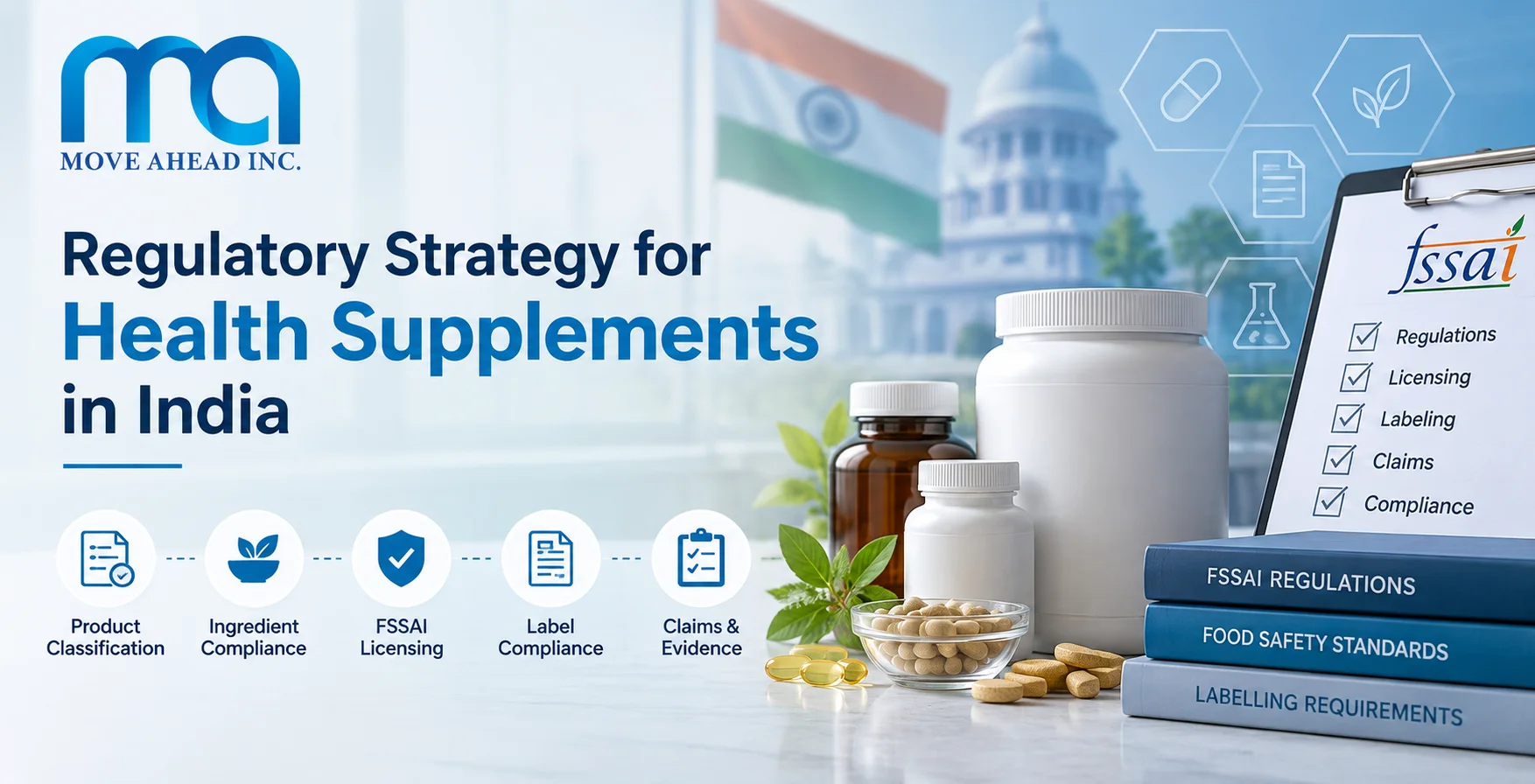
Health supplement regulatory compliance in India begins by classifying the proposed product correctly, mapping every ingredient and level to the applicable food rules, checking the manufacturing and licensing route, building evidence for intended use, controlling claims and designing a compliant label. The work should start before formula and packaging are frozen. A product that is technically manufacturable can still face launch delays if its category, ingredient status, dosage form, claims or importer responsibilities are unclear.
MoveAhead provides food product compliance, food label compliance and related licensing support. This guide is a planning framework, not a substitute for a current product-specific legal opinion. Teams should verify the latest FSSAI regulations, directions, advisories and licence conditions for their exact formula and business model before manufacture, import or sale.
Why Regulatory Strategy Must Start Early
Regulatory decisions influence ingredient sourcing, dose, serving size, claims, flavour system, testing, stability, artwork, manufacturing site and launch date. If compliance review begins only after the commercial formula is approved, the team may need to reformulate or discard printed packaging.
A strategy should identify decisions, owners, evidence and review gates. Marketing, R&D, quality, sourcing, legal, manufacturing and e-commerce teams must work from the same approved product description.
Map the Applicable Regulatory Framework
The FSSAI framework includes category-specific requirements for health supplements and nutraceutical products as well as horizontal rules for licensing, food-product standards, additives, contaminants, packaging, labelling and advertising or claims. Product teams should work from current official texts and amendments rather than an old checklist.
The official FSSAI health supplements resource, food regulations page and current labelling compendium are useful source documents. Record the version and access date used for each decision because requirements can change.
Build a Product Classification Memo
| Question | Why it matters | Evidence |
|---|---|---|
| What is the intended category? | Determines category-specific composition and labelling | Written classification rationale |
| Who is the target consumer? | Affects suitability, warnings and claims | Target-user statement |
| What is the intended purpose? | Separates nutrition support from medicinal positioning | Approved intended-use wording |
| What is the dosage form? | May affect category fit and consumer directions | Product description and presentation |
| Are any ingredients novel or specially controlled? | May trigger additional review or approval | Ingredient-status assessment |
| Is the product imported? | Adds importer, overseas site and documentation interfaces | Import responsibility map |
The memo should explain why the product fits the proposed category and why adjacent categories do not apply. Keep the rationale with formula and label approvals. Classification should not be inferred only from competitor packaging.
Create an Ingredient Regulatory Inventory
List every active ingredient, nutrient, botanical, excipient, additive, flavour, carrier, processing aid and capsule or coating component. Record common name, scientific name where applicable, source, part used, specification, quantity per serving and daily intake.
For each ingredient, identify the regulatory permission, limits, purity requirements, restrictions, warnings and supporting document. Trade-name blends need full composition disclosure under confidentiality controls; a blend certificate without component levels is not enough for regulatory assessment.
Evaluate Nutrient Levels and Daily Intake
Compliance should be assessed at the recommended daily usage, not only per tablet or scoop. Multiple servings, overages used for shelf life and contributions from compound ingredients can change the final daily level. Use one controlled calculation sheet linked to the master formula.
Where the rules reference recommended dietary allowances or other limits, document the source and population basis. Avoid carrying numbers from international markets into an Indian product without review.
Botanicals and Ingredient Identity
Botanical materials need clear species, plant part, extraction ratio or solvent where relevant, marker compounds, contaminants and authentication. Common names can refer to different species, and the same species may have different permitted uses depending on the part or preparation.
Supplier qualification should cover identity, adulteration risk, pesticides, heavy metals, microbes and batch variability as appropriate. Traditional use does not remove the need for current regulatory permission and quality specifications.
Novel Ingredients and Unclear Status
If an ingredient, process, source or intended use is not clearly covered, stop the normal launch path and assess whether a specific approval or clarification is required. Do not assume that sale in another country establishes permission in India.
Create a risk decision with the evidence reviewed, questions outstanding and responsible owner. Commercial pressure should not convert uncertainty into silent acceptance.
Formulation Feasibility Review
A compliant ingredient list must also produce a stable and safe formulation. Review interactions, solubility, sensory load, dosage form, excipient need, allergen cross-contact, moisture and packaging protection. Check whether a consumer can realistically follow the proposed serving.
Regulatory and technical teams should approve the same formula revision. If flavour masking, processing loss or stability overage changes quantities, repeat the compliance calculation before pilot or commercial production.
Supplier Documentation and Qualification
| Supplier document | Compliance purpose |
|---|---|
| Ingredient specification | Confirms identity, composition and acceptance limits |
| Certificate of analysis | Supports batch release against specification |
| Source and process statement | Clarifies origin and manufacturing route |
| Allergen or GMO declaration | Supports label and risk review where relevant |
| Contaminant and microbiology data | Supports safety assessment |
| Regulatory status statement | Provides supplier evidence but requires independent review |
| Change notification agreement | Prevents unreviewed source or process changes |
A supplier declaration is evidence, not the final legal conclusion. Quality and regulatory teams should evaluate its scope, date and relation to the exact supplied material.
Manufacturing Site and FSSAI Licensing
Confirm that the food business operator, manufacturing or repacking site, marketer and importer where applicable hold the correct licence scope and product category. The appropriate route depends on the operation, capacity, location and other current criteria.
MoveAhead’s food licence service provides context on licensing support. The launch file should map every party’s responsibility for manufacture, testing, label approval, batch release, complaints and recall.
Contract Manufacturing Controls
For third-party manufacture, the brand owner should conduct technical transfer and approve the site, formula, batch size, process controls, specifications, artwork and release procedure. The agreement should state who submits or maintains licences and who owns regulatory records.
Do not treat the contract manufacturer’s existing portfolio as proof that a new formula is compliant. Each product needs its own classification, ingredient, label and claim review.
Product Approval and Escalation Path
Some products or ingredients may require a formal approval, additional evidence or a revised formulation. Define an escalation path before the project reaches artwork. The path should include regulatory assessment, data-gap review, decision authority and impact on timeline.
MoveAhead lists product approval support. Businesses should obtain a written scope that identifies what is being assessed, which filings are included and which scientific or laboratory evidence remains the client’s responsibility.
Claims Strategy Before Copywriting
Create a claim matrix covering product name, front-of-pack statements, nutrient or ingredient claims, general wellness statements, website copy, marketplace listings, advertisements, testimonials and influencer content. Every claim should have a regulatory basis and substantiation appropriate to its wording.
Avoid language that presents a food as diagnosing, treating, curing or preventing disease. Qualifiers and mandatory disclosures must be visible and consistent. A disclaimer cannot rescue an otherwise prohibited or misleading headline.
Health Claims Evidence File
Keep the exact approved claim, intended audience, evidence search, studies or authoritative sources, ingredient and dose match, limitations and approval date. Evidence for an ingredient at another dose or in another population may not support the finished product statement.
Review evidence again if formulation, serving, target group or claim wording changes. Maintain a clear separation between traditional-use information, scientific findings and legally permitted advertising language.
Label Compliance Architecture
Design the label from a structured content sheet rather than writing directly in artwork. Map the product category declaration, ingredient list, nutrition or nutrient information, serving and usage directions, warnings, storage, allergen information, vegetarian or non-vegetarian symbol where applicable, FSSAI details, batch and date coding, net quantity, consumer care and other mandatory statements.
The current FSSAI Labelling and Display Regulations should be reviewed with category-specific rules. Confirm minimum type size, contrast, panel location and online display requirements for the actual package.
Warnings Directions and Target Consumer
Usage directions should match the assessed daily intake and dosage form. Add category, ingredient and population warnings where required. If the product is not intended for children, pregnancy, lactation or people with particular conditions, the wording should be medically and legally reviewed rather than copied from a competitor.
Warnings must be readable and placed where the rules require. Keep product inserts, website directions and customer-support scripts consistent with the approved label.
Packaging and Stability Strategy
Packaging should protect the product from moisture, oxygen, light, contamination and physical damage for the intended shelf life. Verify material suitability and compatibility with powders, oils, botanicals or active ingredients. Tamper evidence and dosing devices may also matter.
The expiry or best-before period should be supported by a stability programme on representative production and final packaging. Include active or marker retention, microbiology, moisture, sensory quality and package performance as relevant.
Testing and Specification Plan
| Testing area | Planning question |
|---|---|
| Identity and assay | How will declared or critical ingredients be verified? |
| Microbiology | Which limits and organisms apply to product and process risk? |
| Heavy metals and contaminants | Which raw materials and finished-product risks require control? |
| Pesticides or residues | Are botanicals or agricultural inputs involved? |
| Additives and preservatives | Are levels within applicable permissions? |
| Physical properties | Do weight, disintegration, moisture or other attributes affect use? |
| Stability | Will compliance and quality remain through shelf life? |
Use competent laboratories and agreed methods. A certificate should identify the batch, method, result, limit and authorization. Test plans should follow risk and regulatory requirements rather than a fixed generic panel for every supplement.
Batch Release and Traceability
Define incoming, in-process and finished-product release checks. Link raw-material lots, production records, packaging lots, test reports and dispatch. No batch should be released merely because the marketing launch date has arrived.
Retain samples and records according to the approved quality system and applicable obligations. Traceability should support rapid identification of affected batches during a complaint or recall.
Advertising E Commerce and Marketplace Control
Online product titles, images, bullets, FAQs and sponsored advertisements are part of the consumer communication. Marketplace teams often create copy after label approval, so add a separate digital-content review gate.
Control distributor and influencer claims through approved content, contracts and monitoring. Removing an unsupported claim from the pack does not solve the risk if the website or seller page continues to make it.
Import and Overseas Manufacturer Interfaces
Imported supplements require coordination of importer licensing, product and ingredient review, overseas manufacturing documents, label adaptation, customs information, samples and release controls. The Indian label cannot be treated as a small sticker exercise after shipment.
Allow time for document gaps, revised artwork and regulator questions. Confirm which party controls formula changes at the overseas site and how the Indian importer receives advance notification.
Post Market Surveillance
Track complaints, adverse-event information, quality defects, returns, online feedback and regulator communications. Escalate signals that may require investigation, medical review, withdrawal or recall. Customer-care staff need a script for collecting useful facts without giving medical advice.
Trend data by batch, product and issue. A repeated taste complaint may be quality-related, while unexpected symptoms or packaging failure need a different response. Document decisions and corrective action.
Change Control After Launch
Ingredient supplier, source, specification, process, dose, flavour, package, manufacturing site, artwork, claim and shelf-life changes all require impact assessment. A commercially minor change can alter regulatory status or label declarations.
Use a formal change request that identifies affected licences, submissions, labels, tests, stability, stock and digital listings. Do not allow procurement to substitute an ingredient before regulatory and quality approval.
A Stage Gate Compliance Plan
- Approve intended use, category and target consumer.
- Complete ingredient-status and daily-intake review.
- Freeze formula specifications and supplier evidence.
- Confirm site licensing, manufacturing and testing responsibilities.
- Approve claims, label content and packaging architecture.
- Complete pilot, stability and release readiness.
- Verify production artwork, digital listings and launch records.
- Activate complaint, recall and change-control systems.
Common Compliance Mistakes
- Copying a competitor’s category, dose or warning without independent review.
- Assessing ingredients per serving but ignoring total daily intake.
- Using a trade blend without complete component disclosure.
- Freezing claims and artwork before classification is approved.
- Treating supplier statements as the final regulatory decision.
- Reviewing the printed label but not e-commerce and influencer claims.
- Changing source, formula or packaging without impact assessment.
- Relying on an old regulation compendium without checking updates.
Documents to Keep in the Product Compliance File
- Classification memo and current regulatory-source register.
- Approved formula, daily-intake calculation and ingredient inventory.
- Supplier specifications, certificates and qualification evidence.
- Claims matrix, substantiation and approved marketing copy.
- Label checklist, artwork approvals and licence information.
- Testing, stability, batch-release and traceability records.
- Contracts, responsibility matrix and change-control history.
- Complaint, investigation, corrective-action and recall records.
Regulatory Intelligence and Source Control
Assign responsibility for monitoring official notifications, directions, advisories and enforcement developments. Maintain a source register that records the document title, version, publication date, relevant clauses, owner and affected products. Summaries from consultants or industry posts can help identify issues but should not replace the primary text.
When a change appears, perform a documented impact assessment across formulas, labels, licences, contracts, stock and marketing. Set a compliance date and transition plan. Archive superseded interpretations so the company can explain why an earlier batch used a different approved position.
Launch Readiness Review
Before the first commercial dispatch, hold a cross-functional readiness review. Confirm licence scope, approved formula, specifications, suppliers, production records, test status, final artwork, online listing, claims, customer-care script, traceability and recall contacts. Every open item needs an owner and documented disposition.
A launch should not proceed on the assumption that missing evidence will arrive later. If the risk is manageable, define a controlled hold or restricted action; if it affects legality or consumer safety, delay release. Record the final authorization and exact product revision.
Internal Training and Sales Governance
Train sales, marketplace, customer-care and influencer-management teams on approved product language and escalation rules. They should know which questions require referral to regulatory, quality or a healthcare professional. Incentives should not encourage unsupported medical promises.
Provide a controlled claim library, current label, usage directions and prohibited examples. Audit live listings and campaign assets periodically. When unauthorized copy is found, correct it across all channels and investigate how it bypassed approval.
Frequently Asked Questions
1. Are health supplements regulated as foods in India?
They fall within the FSSAI food-regulatory framework, with category-specific and horizontal requirements that must be checked for the exact product.
2. Is FSSAI licensing enough to launch a supplement?
No. The product, ingredients, levels, claims, label, manufacturing and quality controls also require review.
3. Can an ingredient sold abroad be used automatically in India?
No. Indian permission, conditions and intended use must be assessed independently.
4. When should product classification be completed?
Before formula, claims and artwork are frozen.
5. How should proprietary blends be reviewed?
Obtain complete component identities and levels under appropriate confidentiality controls.
6. Can a health supplement claim to cure disease?
Food communications should not make medicinal disease-treatment or cure claims; exact wording needs current regulatory review.
7. Does a disclaimer make any claim acceptable?
No. A disclaimer does not correct a prohibited or misleading main claim.
8. What should be checked on the label?
Review category declarations, ingredients, nutrition information, usage, warnings, licence details, dates, quantity and other applicable statements.
9. Is laboratory testing mandatory for every parameter?
Testing should meet applicable requirements and product risk; the plan is product-specific.
10. What changes require regulatory review?
Formula, supplier, source, process, dose, claims, label, packaging, site and shelf-life changes can all matter.
11. Who is responsible when a product is contract manufactured?
Responsibilities must be written, but the brand owner and licensed operators cannot assume the other party has handled every compliance step.
12. How often should the compliance strategy be updated?
Review it when rules change and whenever the product, supply chain, claims or business model changes.
Build Compliance into the Formula Before the Launch Clock Starts
A reliable health-supplement launch is built through documented classification, ingredient review, controlled claims, verified labels and a functioning quality system. Review MoveAhead’s services and About Us information, then use the Contact Us page to share the product concept, formula, target consumer, manufacturing route and draft claims for a scoped regulatory assessment.





-
Regulatory Strategy for Health Supplements in India
Posted on Oct 07, 2026
-
Food Additive Compliance: What Manufacturers Should Review
Posted on Sep 30, 2026
-
How to Identify Reliable Ingredient Sourcing Partners
Posted on Sep 23, 2026
-
FSSAI Renewal
Posted on Mar 24, 2026
-

The Importance of Compliance in Cosmetic Regulations
Posted on Jul 28, 2025
-
How to Avoid Misleading Cosmetic Claims in India: A Guide to Regulatory Compliance and Responsible Marketing
Posted on Jul 04, 2025
-

FSSAI Compliance in 2025-How to Get Food Compliance in 5 Easy Steps
Posted on Apr 17, 2025
-
Importance of Product Compliance
Posted on Jun 27, 2024
-
12 Myths about Food Product Compliance
Posted on Sep 21, 2023
-

Rutf Foods
Posted on Feb 22, 2023