
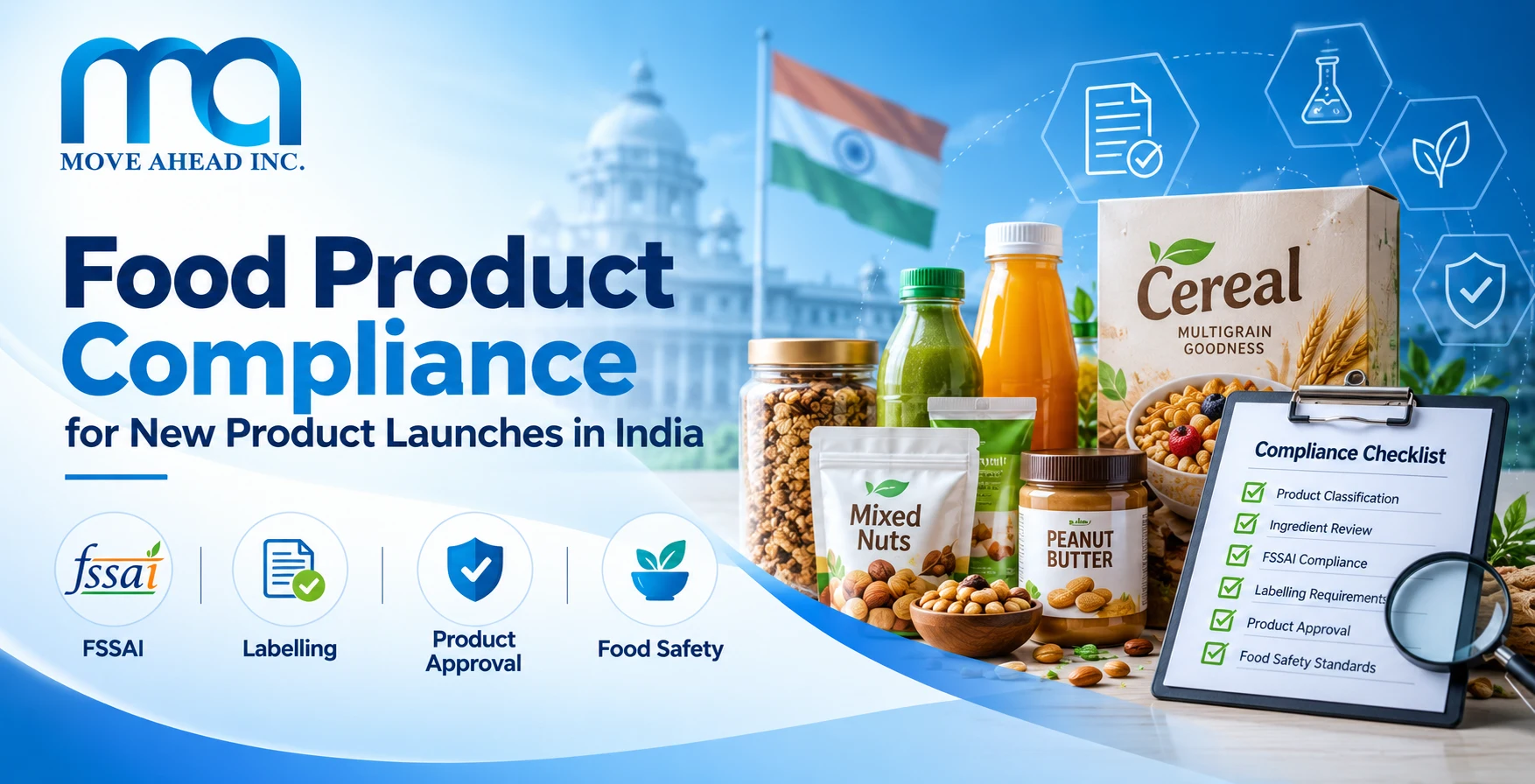
Food Product Compliance for New Product Launches in India
 21st October, 2026
Food Product Compliance for New Product Launches in India
A new food product can look ready long before it is ready for the market. The recipe may be final, the packaging may be designed and the manufacturing partner may be selected, but commercial launch still depends on a series of regulatory and technical checks. If those checks are delayed until the last stage, businesses often face label rework, packaging losses, approval queries, delayed listings and avoidable launch costs.
Food product compliance India is therefore not only a licensing task. It is a launch-readiness process that connects product classification, formulation, ingredients, testing, claims, labelling, manufacturing controls, documentation and post-launch responsibilities. Each decision affects the next one. A change in an ingredient can change the nutrition panel. A new claim can require new evidence. A change in the manufacturing site can affect licensing and technical records.
This guide explains how businesses can prepare for a compliant food product launch in India and when professional support may be useful. Requirements depend on the product, category, ingredients, intended use, manufacturing activity and sales model. The final product-specific position should always be checked against the latest applicable requirements and professional regulatory advice.
What Does Food Product Compliance India Mean?
Food product compliance India refers to the process of ensuring that a food product and the business selling it meet the applicable safety, composition, labelling, licensing, packaging, advertising and documentation requirements. It covers the product before launch and the controls that continue after commercialisation.
For a new product, the central question is not simply whether the business has an FSSAI licence. The business must also establish whether the product is permitted, whether its ingredients and levels are acceptable, whether the product is manufactured under suitable controls, whether the label is accurate, and whether marketing claims can be supported.
This is why new food product compliance should begin during product development. Waiting until the packaging is printed or inventory is manufactured makes corrections more expensive and can force the business to choose between delaying the launch and accepting unnecessary risk.
Why Compliance Planning Should Start Before Product Development Is Complete
Early compliance review gives the business room to make sensible commercial decisions. It can identify an ingredient that may create approval difficulty, a claim that requires stronger evidence, or a product category that demands more documentation. It also helps the team decide what information to request from suppliers and manufacturers before contracts and artwork are finalised.
- It reduces the chance of reformulating after production has started.
- It helps estimate testing, dossier, labelling and approval requirements.
- It prevents sales and marketing teams from building campaigns around risky claims.
- It improves communication between the brand owner, manufacturer, designer and regulatory consultant.
- It creates a clearer launch timeline for licensing, product approval and packaging.
Step 1 Confirm the Product Identity and Regulatory Category
Begin with a product profile, not a form. Write down the product name, format, ingredients, intended consumer, serving size, route of consumption, proposed use, manufacturing method, shelf life, pack size and sales channels. This information helps determine which food product regulations are relevant.
The product could be a conventional food, proprietary food, beverage, food supplement, nutraceutical, fortified product, imported food or another category requiring specific review. Products containing botanical extracts, novel ingredients, concentrated nutrients or specialised actives may need a deeper assessment than a standard food with familiar ingredients.
Marketing language should not be used as the only basis for classification. Terms such as wellness product, immunity blend or natural health food may describe a commercial position, but they do not replace a technical assessment of composition and intended use. The intended consumer also matters. A product positioned for children, athletes, pregnant women or people with a medical condition may raise additional questions around claims, warnings and evidence.
Step 2 Conduct a Full Formulation and Ingredient Review
Prepare a complete formulation sheet listing every ingredient and its percentage or quantity. Include colours, flavours, preservatives, stabilisers, acidity regulators, cultures, processing aids, carriers, vitamins, minerals and other minor components. For each ingredient, collect the common name, technical name where relevant, function, source, specification and supplier documentation.
The review should confirm that ingredients are suitable for the proposed category and that their levels are within applicable limits. It should also consider allergen declarations, purity, contaminants, interactions in the finished formulation and the effect of processing. An ingredient that is acceptable in one food category may not automatically be acceptable in another.
This review is especially important when the product uses an extract, a concentrated active or an ingredient that is not commonly used in the Indian market. If the product or ingredient does not clearly fit an existing standard, the business should assess whether a product approval pathway or technical submission is required before committing to a commercial launch.
Step 3 Decide Whether Product Approval Is Required
Product approval is a key consideration for products or ingredients that are non-specified or do not clearly comply with an existing applicable standard. A business should not assume that an ingredient is acceptable simply because it is available in another country or used by another brand.
A product approval submission may require a technical dossier containing the formula, ingredient information, certificate of analysis, technical data sheet, method of analysis, manufacturing flowchart, proposed label and scientific or safety evidence. Depending on the product, supporting research may include toxicology, efficacy, stability or other technical material.
The earlier this question is addressed, the better. Product approval can influence the product name, formula, evidence plan, launch date and commercial budget. MoveAhead supports product approval-related work including technical dossier preparation, portal filing, document review, laboratory coordination and responses to regulatory queries.
Step 4 Verify the Manufacturing Route and FSSAI Licence Position
A new product may be manufactured in the brand owner’s facility, through a contract manufacturer, or through more than one site. The business should identify who is responsible for manufacturing, packing, storage, labelling and release of the finished product. The applicable FSSAI registration or licence should reflect the actual activity and premises.
Manufacturers, repackers, relabellers, importers, distributors, retailers, e-commerce operators and other food business operators may have licensing or registration obligations depending on their activities. The business should check the scope, address, category and validity of the relevant licence rather than treating a generic licence as proof that every activity is covered.
For contract manufacturing, put responsibilities in writing. The agreement should cover the approved formula, raw material specifications, batch records, testing, release criteria, deviations, complaints, recalls, change control, records ownership and approval of label artwork. The brand owner remains responsible for ensuring that the product it sells is properly represented and supported by accurate records.
MoveAhead provides assistance with fresh, modification and renewal applications, document preparation, technical and administrative review, application monitoring, annual returns where applicable and responses to queries raised during the process.
Step 5 Build the Product Safety and Testing Plan
Testing should be planned around the product’s risk profile, ingredients, processing method, shelf life and regulatory requirements. A single laboratory report cannot automatically prove every aspect of compliance. The testing plan may include microbiological parameters, nutritional composition, contaminants, heavy metals, pesticide residues, allergens, additives or stability-related checks.
Use suitable laboratories and retain the complete context of each report: sample identity, batch number, date, test method, specification and result interpretation. Supplier certificates can support the file, but the finished product may still require its own testing. If the formulation, process or supplier changes, reassess whether the existing testing evidence remains valid.
Testing should also support the commercial claims the business intends to use. If the label says high protein, sugar-free, source of fibre or another defined claim, the business should have a reliable basis for the statement. If a claim implies a health or therapeutic benefit, the evidence and wording require additional caution.
Step 6 Prepare a Compliant Label Before Printing
Food labelling is one of the most visible parts of launch compliance. The label should be reviewed against the final formula, pack size, manufacturing arrangement and sales market before the artwork is sent for printing. The review should cover the legal identity of the food, ingredient list, allergen information, nutrition information, net quantity, batch or lot details, date marking, storage conditions, directions for use, business details, FSSAI details and other applicable declarations.
The label must match the product that will actually be manufactured. If the recipe changes after artwork approval, the label should be reviewed again. If the manufacturing site or marketer details change, those details may also need to be updated. Imported foods can require additional checks for importer information, country of origin and presentation in the Indian market.
Review the label and the digital product listing together. Online descriptions, product images, marketplace content and social media claims should not contradict the approved pack or create stronger promises than the evidence supports. MoveAhead’s food label compliance service includes review of new or existing labels, nutrition information and nutrition, health and content claims.
Step 7 Review Nutrition, Health and Marketing Claims
Claims often become a launch risk because they are created by marketing teams after the product formula has already been approved. Build a claim register containing every statement proposed for the pack, website, marketplace listing, brochure, advertisement and social media post.
For each claim, ask three questions: Is the wording permitted for the product and category? Is the statement clear to an ordinary consumer? Can the business support it with reliable evidence? Terms such as natural, healthy, immunity, clinically proven, supports digestion, detox, sugar-free and high protein should not be used casually. A claim can be misleading because of its wording, even when the ingredient behind it is present.
Keep approved claim wording separate from creative alternatives. If a campaign team changes a sentence, the new version should pass through review before publication. This simple control prevents the label, website and advertisements from making different promises about the same product.
Step 8 Check Packaging and Legal Metrology Declarations
Food compliance also connects with packaging and quantity declarations. Pre-packaged products may require information such as net quantity, manufacturer or packer details, consumer care information, retail sale price and other declarations under applicable legal metrology requirements.
Check whether mandatory information remains visible after sealing, shrink-wrapping, placing the product in an outer carton or displaying it on a shelf. Confirm that the declared pack size matches the actual quantity and that the same information is used in invoices, product listings and distributor documents where relevant.
Step 9 Assemble the New Product Compliance File
Before launch, create one controlled compliance file for the product. It should be easy to understand by someone who was not involved in formulation or packaging. A well-organised file reduces delays when a retailer, marketplace, distributor, auditor or authority asks for information.
- Product profile and category assessment
- Final formula and ingredient specifications
- Supplier certificates and raw material records
- Manufacturing flowchart and finished product specification
- Laboratory reports and certificates of analysis
- Approved label artwork and claim evidence
- FSSAI registration or licence documents
- Product approval dossier or approval correspondence where applicable
- Batch, traceability, complaint and recall procedures
- Change-control history and post-launch review records
Use version control. The approved formula, label, specification and online listing should refer to the same product version. When a supplier, flavour, pack size, facility or claim changes, record the change and assess its compliance impact before implementation.
Launch Readiness Checklist
| Launch area | Decision to complete | Documents or evidence |
|---|---|---|
| Category | Product identity and route confirmed | Product profile and assessment |
| Formula | Ingredients and levels reviewed | Formula and specifications |
| Approval | Need for product approval assessed | Dossier or review note |
| Licence | Activity and premises covered | FSSAI registration or licence |
| Safety | Testing plan and release criteria approved | Lab reports and batch records |
| Label | Artwork matches final product | Approved label and claim review |
| Launch | Online and offline content aligned | Listing, campaign and change log |
Common Launch Mistakes to Avoid
- Finalising packaging before product classification and formulation review
- Assuming an existing FSSAI licence covers every product or facility
- Using a competitor label as a template without checking current requirements
- Treating supplier COAs as a complete finished-product safety file
- Approving health or nutrition claims without a documented evidence review
- Changing the formula after label approval without updating the artwork
- Ignoring e-commerce listings and social media while reviewing claims
- Starting product approval only after inventory and launch campaigns are ready
When Should You Work With a Food Regulatory Consultant?
Professional regulatory support is valuable when the product uses specialised ingredients, makes health or nutrition claims, is imported, is manufactured through a third party, falls outside a clear standard, or requires product approval. It is also useful when a business is launching several SKUs and needs a consistent review system.
A consultant can help interpret applicable requirements, review the formulation, identify document gaps, coordinate with laboratories, assess labels and claims, prepare a technical dossier and support responses to regulatory queries. The practical benefit is not only filing assistance. It is the ability to identify problems early enough for the business to correct them without disrupting the launch.
MoveAhead supports food product compliance through composition evaluation, ingredient and additive review, regulatory interpretation, feasibility assessment, food label compliance, FSSAI licensing support and product approval-related services. Its team can help businesses organise the technical and administrative work required for a new product launch.
Frequently Asked Questions About New Food Product Compliance
1. What is food product compliance India?
It is the process of confirming that a food product, its formulation, manufacturing, label, claims, licence and supporting records meet the applicable requirements in India.
2. When should compliance review begin for a new food product?
It should begin during product development, before the formula, claims and packaging are finalised. Early review reduces expensive changes close to launch.
3. Is FSSAI compliance the same as getting an FSSAI licence?
No. A licence covers the relevant business activity, but the product, ingredients, label, claims, safety controls and records must also be compliant.
4. What is checked during a new food product compliance review?
The review can include product category, ingredients, additives, levels of use, allergens, safety, testing, packaging, labelling, claims, licensing and product approval requirements.
5. When is product approval required?
It may be required when a product or ingredient is non-specified or does not clearly fit an applicable standard. The exact route depends on the product and current requirements.
6. Do imported food products need additional compliance checks?
Yes. Imported products may require checks relating to ingredients, documentation, importer details, labelling, country of origin and the Indian market presentation.
7. Does a contract manufacturer’s licence cover the brand owner?
Not automatically. The scope, premises, activity and responsibilities should be checked, and the brand owner should maintain its own product and compliance records.
8. What documents are needed for product approval?
Depending on the product, documents may include formula, COA, TDS, method of analysis, label, manufacturing flowchart, specifications and scientific or safety evidence.
9. Can a business print the label before receiving all test reports?
It is safer to complete the required formulation, nutrition, claim and label review before printing. Test results or formulation changes may require artwork changes.
10. Are online product descriptions part of compliance?
Yes. Marketplace pages, websites, advertisements and social media can create consumer-facing claims and should align with the approved label and evidence.
11. What happens if the product formula changes after approval?
The business should perform a change-impact review covering category, ingredients, allergens, nutrition, claims, testing, shelf life and label declarations.
12. How long does food product approval take?
The timeline varies by product, dossier completeness, authority queries, laboratory evidence and the applicable route. A product-specific assessment is needed before estimating time.
13. What is a product compliance file?
It is a controlled collection of the product profile, formula, specifications, test reports, label, claims, licence documents, approval records and change history.
14. Can MoveAhead review an existing food product?
Yes. A review can assess composition, ingredients, additives, label declarations, nutrition information, claims, licensing position and documentation gaps.
15. How can MoveAhead help with a new product launch?
MoveAhead can support food product compliance, FSSAI compliance, product approval, formulation review, label evaluation, technical documentation and regulatory query responses.
Final Takeaway
A compliant launch is built before the product reaches the market. Confirm the category, review every ingredient, assess product approval, verify the manufacturing and licence position, plan testing, approve the label, substantiate claims and maintain a controlled compliance file. This sequence helps businesses protect the launch timeline while reducing the risk of rejected packaging, regulatory queries and post-launch corrections.
If you are preparing to launch a new food product in India, contact the MoveAhead team for support with food product compliance India, FSSAI compliance, product approval, food label review, licensing and technical documentation.





-
Food Product Compliance for New Product Launches in India
Posted on Oct 21, 2026
-
Custom Clearance Support for Regulatory-Compliant Imports
Posted on Oct 14, 2026
-
Regulatory Strategy for Health Supplements in India
Posted on Oct 07, 2026
-
Food Additive Compliance: What Manufacturers Should Review
Posted on Sep 30, 2026
-
How to Identify Reliable Ingredient Sourcing Partners
Posted on Sep 23, 2026
-
FSSAI Renewal
Posted on Mar 24, 2026
-
The Importance of Compliance in Cosmetic Regulations
Posted on Jul 28, 2025
-
How to Avoid Misleading Cosmetic Claims in India: A Guide to Regulatory Compliance and Responsible Marketing
Posted on Jul 04, 2025
-
FSSAI Compliance in 2025-How to Get Food Compliance in 5 Easy Steps
Posted on Apr 17, 2025
-
Importance of Product Compliance
Posted on Jun 27, 2024