
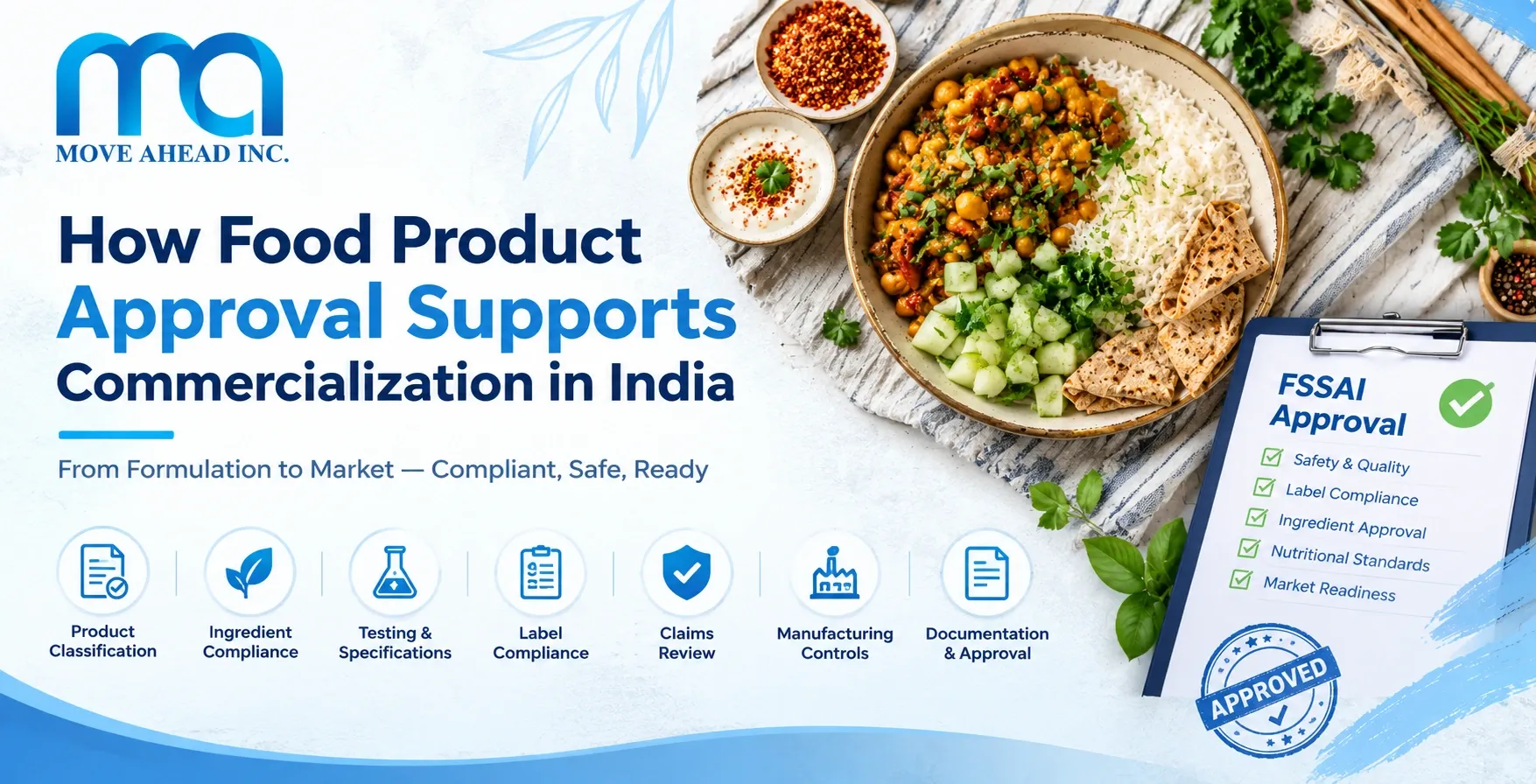
How Food Product Approval Supports Commercialization in India
 28th October, 2026
How Food Product Approval Supports Commercialization in India
Food commercialization is not complete when a recipe tastes good or a package looks ready. A product also needs a defensible route under the applicable food framework, suitable ingredients, controlled specifications, compliant labelling, appropriate claims and a supply chain that can support the file. Food product approval in India is therefore best understood as a stage of product development and risk management, not a last-minute formality after production has begun.
The first question is what the product is, not what it will be called in marketing. Define its format, intended consumers, serving size, ingredients, additives, processing, nutritional profile, claims and route to market. MoveAhead’s food compliance services describe formulation evaluation as a step-by-step review of composition against applicable requirements.
Classify the Product and Ingredient Set
A development team should map every ingredient, processing aid, additive, flavour, nutrient and active component against the intended product category. The same ingredient can present a different question depending on its source, form, level of use, target population or product positioning. Avoid treating a supplier brochure or overseas approval as proof that an ingredient can be used in the proposed Indian food product without further assessment.
Where a non-specified or novel food or ingredient route may apply, the official FSSAI E-PAAS platform describes the product approval and application management process. The appropriate pathway should be confirmed from the current rules and product facts. Do not frame an approval outcome as guaranteed before the dossier and regulatory basis have been evaluated.
Build the Product Dossier as Development Proceeds
The strongest commercialization file is assembled while the product is being developed. Preserve ingredient specifications, certificates of analysis, safety information, manufacturing process flow, batch formulation, finished-product specifications, stability or shelf-life rationale, packaging details, label artwork and proposed claims. Waiting until a buyer, regulator or marketplace asks for records can delay a launch and lead to inconsistent documents.
Assign one controlled version of the formulation. If an ingredient source, level or claim changes, review the regulatory and label impact before production. This discipline matters especially when commercial teams request flavour variants, claim additions or cost reductions late in development. A minor procurement change can alter the compliance position.
Formulation Review Protects Product Viability
A formulation review checks whether the planned composition and ingredient levels are suitable for the proposed food category and intended use. It can also identify questions around additives, nutrients, botanical ingredients, allergens, contaminants, specifications and intended claims. The purpose is not merely to find a technical objection; it is to give the business a reliable basis for deciding whether to reformulate, obtain more evidence or proceed.
MoveAhead states that it assists with composition evaluation, ingredient and additive review, and regulatory interpretation. Use a food product compliance enquiry to bring technical and commercial inputs together early, rather than separating regulatory review from product-development decisions.
Label Review Is Part of Commercialization
A food label connects the product’s regulatory position with what the consumer sees. Product name, ingredient declaration, allergen information, nutrition information, declarations, net quantity, manufacturer or marketer details, date marking, storage directions and claims must be reviewed against the actual final product. Label artwork should not move to print while key formulation or claim questions remain open.
Marketing claims need particular care. Statements about nutrition, health, performance, naturalness, origin or suitability can change how the product is interpreted. Create a claims register that links each proposed statement to its substantiation and approval status. This protects retailers, sales teams and digital marketers from publishing a claim that the technical file cannot support.
Plan Manufacturing and Supply Chain Controls
Commercialization requires the factory and suppliers to reproduce the reviewed product consistently. Agree raw-material specifications, approved supplier list, incoming checks, batch records, cleaning controls, allergen management, packaging controls and finished-product release criteria. The regulatory file should be compatible with what the manufacturer can actually document at scale.
For imported ingredients or products, add import, customs, shelf-life, labelling and local release controls to the launch plan. MoveAhead lists regulatory and import-related services across its offerings, so businesses can coordinate food compliance with the broader operational requirements rather than treating the product file in isolation.
A Practical Launch Gate Process
| Launch gate | Core decision | Evidence to review |
|---|---|---|
| Concept | Is the intended product pathway plausible? | Product brief and preliminary ingredient list |
| Development | Does the formulation support the category and claims? | Formula, specifications and technical review |
| Artwork | Does the label match the final product? | Controlled artwork and claim register |
| Supply | Can suppliers and factory reproduce it? | Specifications, process and quality plan |
| Launch | Are approvals, records and responsibilities in place? | Final dossier and release checklist |
Treat each gate as a cross-functional decision involving regulatory, R&D, quality, procurement, manufacturing and commercial teams. A short documented approval at each stage is more useful than a large review at the end. It gives the business time to adjust the formulation or launch plan while options are still available.
Avoid Common Commercialization Delays
Common causes of delay include a late ingredient substitution, incomplete supplier data, a label drafted from an old formulation, unsupported claims, no clear product-category rationale and unplanned imported-material lead times. These issues are easier to solve before promotional spend and production slots have been committed.
Keep a decision log that identifies open questions, owner, evidence needed and deadline. Escalate questions that could change the launch date or product positioning. A transparent log allows management to make an informed commercial decision rather than discovering a gap during customer onboarding or inspection.
Post Launch Compliance Still Matters
After launch, maintain the technical file, monitor supplier and formula changes, retain production records and review complaints for signals related to labelling, quality or intended use. A product can evolve through pack-size changes, new channels, reformulation or claim updates; each change should be screened before implementation.
Commercialization is successful when the product can be supplied consistently, communicated responsibly and supported by accessible evidence. Early product approval planning helps make that outcome repeatable across future SKUs, rather than creating a new scramble for every launch. Get read more About us .
Frequently Asked Questions
1. Does every food product need the same approval process?
No. The appropriate route depends on the product category, formulation, ingredients, claims and current regulatory requirements.
2. When should regulatory review start?
Start at concept or early formulation stage, before packaging, production commitments and promotional claims are finalised.
3. Why are supplier specifications important?
They support formulation review, traceability and consistent manufacturing. A supplier change can affect the product’s compliance position.
4. Can label review wait until packaging is printed?
It should be completed before print approval, using the controlled final formulation and claims plan.
5. What is E-PAAS?
It is FSSAI’s official electronic product and claim approval platform for relevant application pathways, including non-specified or novel food and ingredients.
6. Can a product be reformulated after launch?
Yes, but the revised formula, label, claims, supplier documents and manufacturing controls should be reviewed before implementation.
Validate the Product Pathway Early
Before investment in a launch, share the proposed formulation, ingredient specifications, product format, claims, source documents and target channel with MoveAhead. A structured early review can identify the evidence and regulatory pathway that should be resolved before commercialization.
Contact Move Ahead to assess your product’s regulatory pathway and prepare for a smoother commercialization process.





-
How Food Product Approval Supports Commercialization in India
Posted on Oct 28, 2026
-
Food Product Compliance for New Product Launches in India
Posted on Oct 21, 2026
-
Custom Clearance Support for Regulatory-Compliant Imports
Posted on Oct 14, 2026
-
Regulatory Strategy for Health Supplements in India
Posted on Oct 07, 2026
-
Food Additive Compliance: What Manufacturers Should Review
Posted on Sep 30, 2026
-
How to Identify Reliable Ingredient Sourcing Partners
Posted on Sep 23, 2026
-
FSSAI Renewal
Posted on Mar 24, 2026
-
The Importance of Compliance in Cosmetic Regulations
Posted on Jul 28, 2025
-
How to Avoid Misleading Cosmetic Claims in India: A Guide to Regulatory Compliance and Responsible Marketing
Posted on Jul 04, 2025
-
FSSAI Compliance in 2025-How to Get Food Compliance in 5 Easy Steps
Posted on Apr 17, 2025